For those who have finished a first cycle in theology. You hold the STB, the Magister theologiae, or an equivalent first-cycle degree, and you are ready to move from mastering the tradition to working within it as a scholar.
Licentiate in Sacred Theology
A two-year pontifical second-cycle degree that trains students to research, teach, and take part in theological debate as scholars in their own right.

From study to scholarship.
The STL forms students to move from receiving theology to contributing to it. After a first cycle spent learning the tradition, you now take up sustained research, write a thesis, and defend it in public before faculty and peers. Within the living tradition of the Church, you learn to hold a limited but significant question with rigor and care, and to speak in the theological conversation as a scholar in your own right.
What is this, in short?
Quick Facts
STL
Degree
2 years
Duration
114 ECTS
Credits
English
Language
Is this for me?
For those ready to research and teach.
For those who want to do real research. You want to take up a limited but significant question, pursue it with method under supervision, and make a genuine contribution through a written thesis and its public defense.
For those preparing to teach and to continue. You are looking toward teaching theology in a seminary or an equivalent setting, and toward the doctoral STD, with the STL as the necessary second step on that path.
What will I actually study?
Coursework, research, and defense.
Advanced seminars and tutorials across the theological disciplines, chosen with an adviser and gathered toward a specialization: this is the shape of the two years below. The second cycle joins three movements, coursework, a supervised thesis, and the public act that closes the degree.
Coursework & Tutorials · 72 ECTS
- Advanced seminars across the theological disciplines
- Tutorials guided by your adviser
- Study spread over six trimesters
- Courses chosen toward a specialization
- Research method and scholarly writing
- Reading of primary sources in the tradition
Master's Thesis · 42 ECTS
- A thesis of about 90 pages
- Written under the supervision of an adviser
- A limited but significant question
- Evidence of training in research
- A real contribution to the field
- Written in English, German, or another agreed language
Lectio Coram · 6 ECTS
- A 45-minute lecture before faculty and students
- Followed by 45 minutes of discussion and questions
- Public defense of the thesis
- Delivered as a scholar in your own right
- The concluding act of the second cycle
The complete STL program of studies. For further details, contact the STL program director, Dr. Gundula Harand.
How does a seminar actually work?
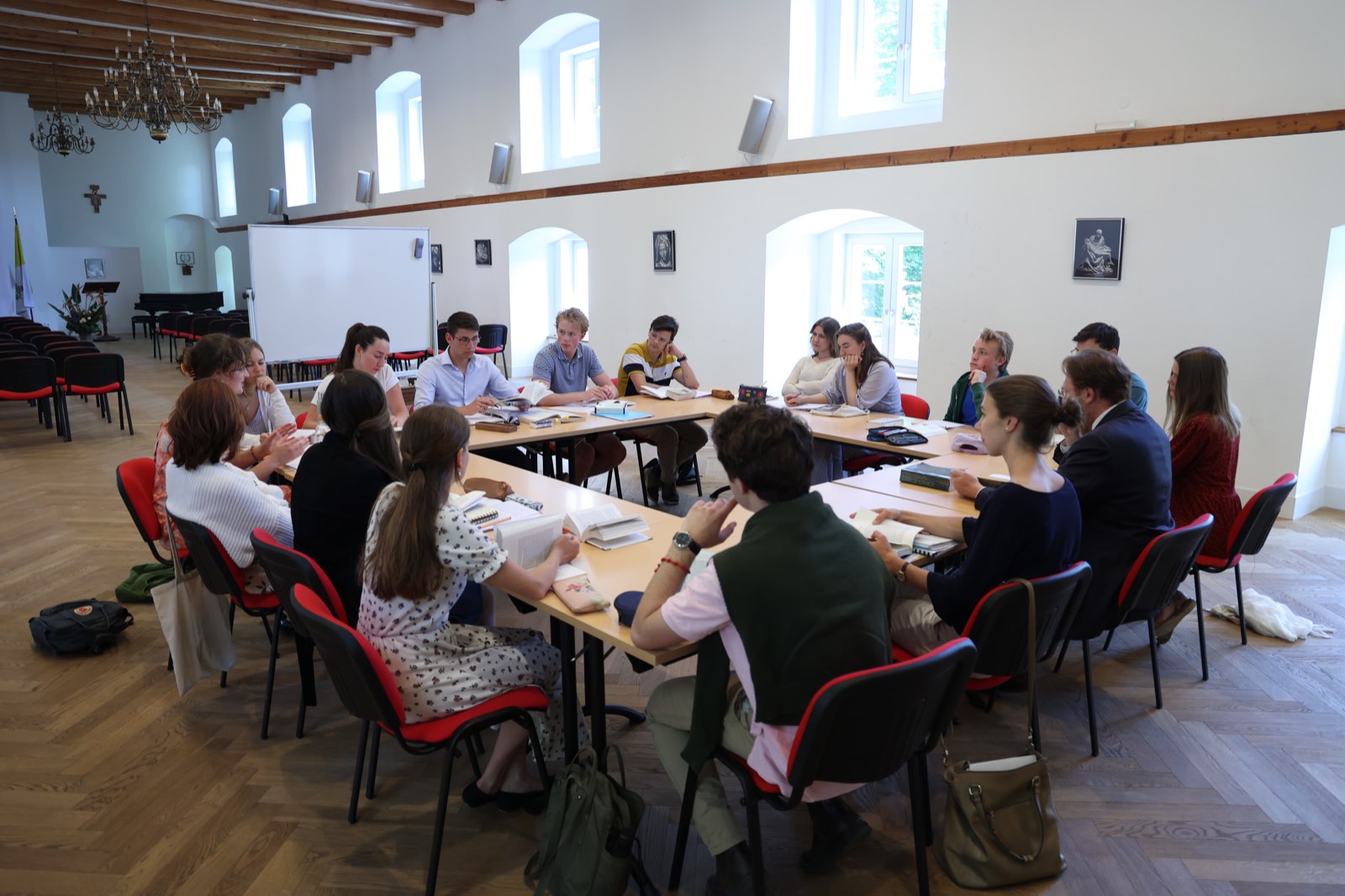
Seminars, an adviser, and ninety pages you have to defend.
The second cycle keeps the seminar of the first: no class exceeds fifteen participants, texts are prepared by reading and re-reading, and the hour moves from your own questions through the arguments of others to conclusions drawn from principles. What is added is the tutorial and the thesis. Title and adviser are chosen by November 30 of the first year, the complete draft is due February 28 and the final text April 30 of the second year. The thesis runs to about 90 pages, 150,000 to 200,000 characters, and is graded by your adviser and two readers, one of whom may come from outside the faculty. It ends in public: a lectio coram of 45 minutes before faculty and students, followed by 45 minutes of discussion and questions.
- Grades follow a ten-point scale, from probatus to summa cum laude. A cumulative average of 8.5 is needed to continue in good standing.
- The thesis must show training in research: a limited but significant question, command of method, mastery of the subject matter, and a real contribution to theological knowledge.
- The grade for the lectio coram is counted into the course average.
- The final degree grade is half the course average and half the thesis with its defense, the written thesis counting 70 percent of that half and the defense 30.
- The thesis is written in English, German, or another modern language agreed with your adviser.
What kind of life is this?
Defend a thesis in public, then kneel beside the people who questioned it.
The STL forms teachers of the Church, and teachers transmit more than arguments; they transmit a way of standing before the truth. Research at this level is embedded in the same praying community as the first-year seminar: the liturgy, the library, and the thesis belong to one life.
Intellectual rigor and intellectual humility are trained together here, and the community is small enough that nobody gets to practise only one of them.
Where does this lead?
Seminary lectern, scholarship, and the third cycle.
Continue into the doctorate. The STL is the necessary step before the third cycle, and graduates are prepared to continue into the doctoral STD and its dissertation.
Teach theology. The degree qualifies its holders to teach theology in a seminary or an equivalent institution, and to guide others in the disciplines they have studied in depth.
Take up scholarship. Graduates carry their research further through writing, publication, and participation in the wider theological conversation.
Serve in ministry. The formation is brought back into the Church, wherever priests, religious, and lay theologians are called to serve with theological depth.
Graduates, and where they went
-
Michel Therrien
President of the Institute for Pastoral Leadership, Diocese of Pittsburgh
-
John Joy & Louis Bolin
Founders of the Albertus Magnus Center for Scholastic Studies
What do graduates say?
What these years become in a life.
“I came to ITI knowing theology. I left knowing how to do it.”
When I began the STL, I had already finished my first cycle and thought the hard work was behind me. What I found instead was a different kind of demand: to take one limited question, live with it for two years, and be answerable for every claim I made about it. The seminars sharpened me, but it was the tutorials with my adviser that taught me what research really asks of a person.
Writing the thesis changed the way I read everything. Ninety pages sounds small until you try to say something true and new on a single question within the tradition. Preparing the lectio coram, standing before faculty and students to lecture and then defend what I had written, was the moment I first felt like a theologian rather than a student of theology.
I am more grateful for those years than I can easily say. The STL gave me the method I now rely on, the confidence to teach, and the foundation I am building on in my doctoral work. If you are discerning this path: come and see. The work is serious, and it will form you.
Practical Details
What applicants need to know.
Prerequisite
Completion of the first cycle, the STB or the Magister theologiae, with honors of cum laude or higher, or theological studies at least equivalent to the first cycle of pontifical theological studies.
English
English is the principal language of instruction. Applicants who have not completed at least two years in an English-speaking environment or at a school with English as the main language of instruction must submit a standardized test score, such as TOEFL iBT 75 or equivalent.
Languages
A basic knowledge of Latin and New Testament Greek is expected before you begin; if necessary, one of the classical languages may be taken during the first year. Fluency in a modern language other than your native language is also required.
Degree
Sacrae Theologiae Licentiatus (STL), the pontifical second cycle.
Thesis
About 90 pages on a limited but significant question, written under supervision, graded with two readers and defended in public, together with the lectio coram.
Documents
Use these for exact requirements, course descriptions, policies, and current academic regulations.
What does it cost?
Tuition, made possible.
12 000 €
Tuition / year
300 €
Registration / year
from 3 000 €
Housing / year
Regular tuition is 25 000 €. Every accepted student automatically receives the Standard ITI Scholarship.
How do I apply?
Everything you need to apply.
For most applicants, the best order is simple: gather your documents, ask for recommendations early, complete the online application, and then follow through quickly on language or visa requirements if they apply to you.
Applications close on July 1 for the academic year beginning in autumn.
Your application checklist
Use this as a working list while you prepare your application.
01
Prepare your documents
Ask for the recommendation letters first: they are the one part of the application you do not control. The rest is a working list.
02
Complete the online application
The application itself is a single online form. Submitting it opens your file with the admissions office.
03
Prove your English
If your previous schooling was not primarily in English, book a standardized test early enough for the score to reach ITI before the deadline. The threshold is listed under the requirements.
04
Apply for a visa in good time
If you need a visa or residence permit, start early. ITI advises submitting residence permit materials before March 1, since the process can take up to six months.
What else do people ask?
Questions applicants usually ask.
Do I need a prior theology degree?
Yes. The STL is a second-cycle degree, so admission requires completion of the STB or the Magister theologiae, or theological studies at least equivalent to the first cycle of pontifical theological studies.
How long is the thesis?
The master's thesis is about 90 pages. It is written under supervision on a limited but significant question and concludes with a public defense.
What is the lectio coram?
The lectio coram is a public lecture of 45 minutes followed by 45 minutes of discussion and questions before faculty and students, held alongside the defense of the thesis.
Can I continue to a doctorate?
Yes. The STL is the necessary step before the third cycle and prepares students to continue into the doctoral STD.
Take the next step
Apply now
If you are ready for an education where study, prayer, and community belong together, apply now. If you are still discerning, plan a visit and experience ITI in person.