For students who want truth, not noise. You want an education that slows you down, deepens your attention, and teaches you to judge reality more clearly. You are not looking for endless information, but for wisdom.
Bachelor in Catholic Liberal Arts
A three year great-books program for students who want their mind, faith, and whole life formed toward wisdom and virtue.

Wisdom before specialization.
Here, study is not reduced to preparation for a career. It is formation for a life rooted in truth, prayer, friendship, and clear thought. In the Catholic Liberal Arts, you learn to read deeply, ask better questions, love what is good, and become free for the vocation God has placed in your heart.
What is this, in short?
Quick Facts
BA
Degree
3 years
Duration
180 ECTS
Credits
English
Language
Is this for me?
If you want wisdom, not only knowledge.
For students who want study and prayer to belong together. You do not want faith kept private and study kept abstract. You want a life in which reading, worship, friendship, and vocation form one coherent whole.
For students who want to become free for what God asks. You are not choosing a program only to qualify for work. You want to become the kind of person who can serve well, think clearly, and respond generously to the vocation placed before you.
What will I actually read?
Three years from wonder to wisdom.
Philosophy, theology, literature, history, natural science, music, rhetoric, classical languages, and the arts of clear thought and speech: these are the disciplines of the three years below. They do not stand side by side as separate subjects. The liberal disciplines build the foundations for philosophy and theology, and the later courses carry students toward metaphysics, Scripture, the Fathers, and St. Thomas Aquinas.
BA 1
- Introduction to Liberal Education
- Latin Grammar
- Logic and Geometry
- Classical Literature
- Ancient Philosophy and History
- Catechism of the Catholic Church
BA 2
- Epistemology and Anthropology
- Natural Philosophy
- Ethics and Political Philosophy
- Church and World History
- Christian Literature
- Salvation History and Interpretation
BA 3
- Metaphysics: Aristotle and Aquinas
- Patrology and St. Augustine
- Introduction to St. Thomas Aquinas
- The One God: Creator and Creation
- Catholic Social Teaching
- Modern Questions and Apologetics
Complete course descriptions for the BA program. Program courses are subject to change.
How does a seminar actually work?
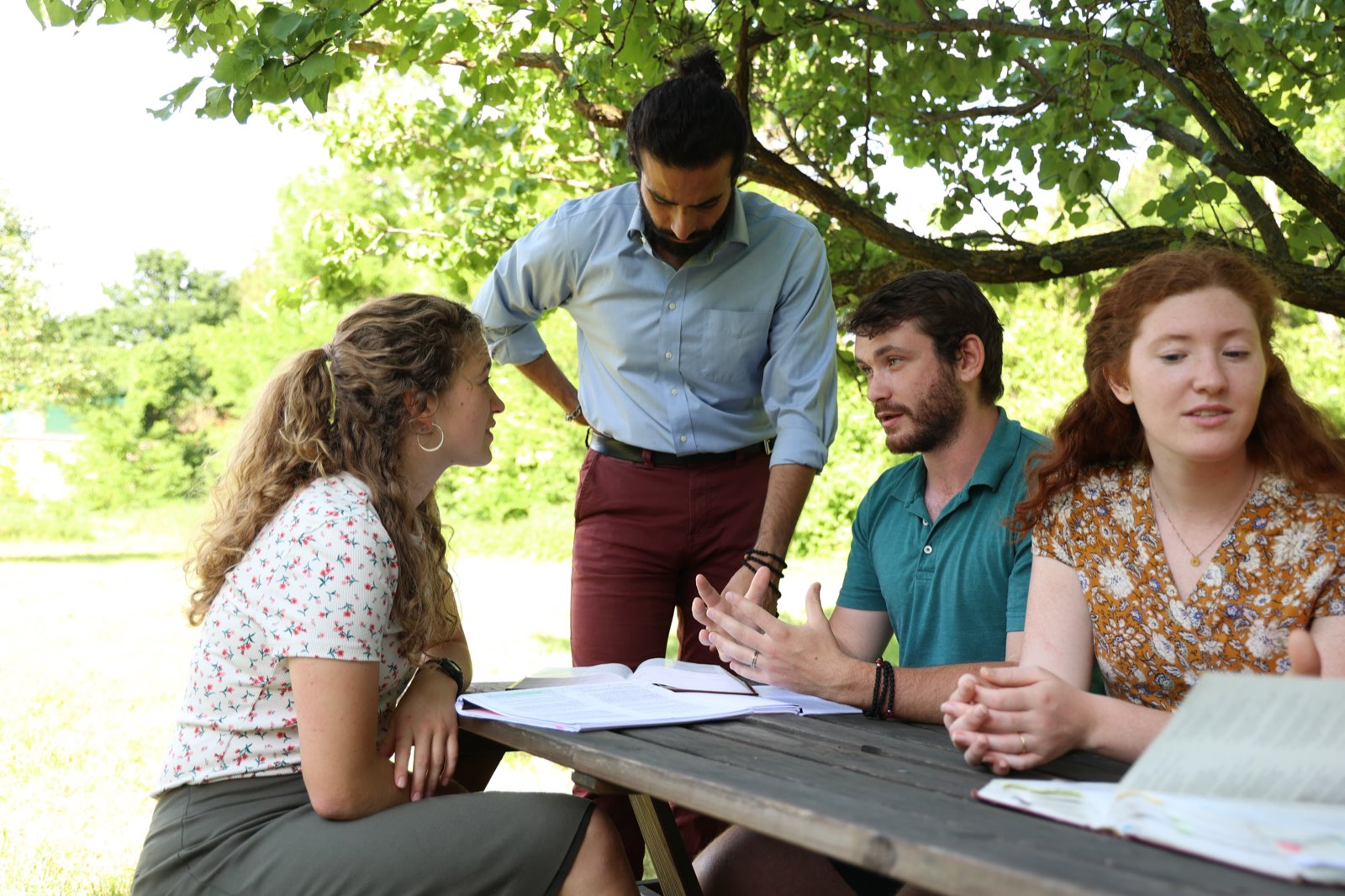
A dozen readers, one table, one text.
Every course is a seminar, and no class may exceed fifteen participants; most gather about a dozen students around one table, with a student-faculty ratio of one to four. You prepare by reading and re-reading the assigned pages, because the books themselves are treated as the lectures of the university. In class the professor opens the text and then asks: you bring your own questions, examine what others have said, and argue from principles to conclusions, addressing one another by last name because the discussion is a public act. Electronic devices stay closed unless a professor allows them. Every class is obligatory, and more than two absences in a course normally means it cannot be completed.
- Written work is of two kinds: a divisio textus, an outline of the author's argument, which many professors expect for every assigned reading, and papers, on average three per term, due one week after the end of exam week.
- Final examinations are not a test of hasty memorization. They ask you to draw a term of reading together into one whole.
- Grades follow a ten-point scale, from probatus to summa cum laude. A cumulative average of 8.5 is needed to continue in good standing.
- The course load is capped at 24 ECTS per term, with language courses added on top where a student still needs them.
- The final degree grade is the average of your course grades; language grades are left out of the calculation, and the optional BA thesis does not count toward it either.
What kind of life is this?
Three years that shape a person more than almost any other.
The BA takes that seriously. Between eighteen and twenty-one, study is joined to sacramental life, shared meals, friendship, and the daily discipline of a community that expects something of you.
The goal is not only a trained mind but a formed person: someone who can read carefully, judge honestly, speak clearly, and order a whole life toward what is true and good. “The truth will set you free” (John 8:32) is the shape of these three years, not a slogan above them.

Where does this lead?
Parish, classroom, and the next degree.
Continue into theology. At ITI, the BA corresponds to the first three years of the Sacred Theology path and prepares students to continue into the full five-year course leading to the pontifical STB, recognized in Austria as the Magister theologiae.
Teach and communicate. The degree prepares students for work in schools, catechesis, publishing, writing, and other fields where clear speech, serious reading, and careful judgment matter.
Lead and serve. Graduates carry this formation into cultural work, nonprofit service, family life, public witness, and roles of responsibility in the Church and in society.
Discern a vocation. Residential Catholic life gives students time and space to discover how study, prayer, friendship, and mission belong together, and to become free for what God asks.
What do graduates say?
What these years become in a life.
“I arrived in Trumau with questions I could barely name. I left with a way of life.”
When I came to ITI, I thought I was choosing a degree. What I actually found was a community that took my questions seriously: professors who read Plato and Aquinas with us line by line, friends who argued about truth over dinner and then knelt beside me at Mass the next morning. Slowly, study and prayer stopped being two separate things in my life. They became one movement toward the same God.
The BA gave me more than knowledge. It taught me how to read slowly, how to speak honestly, and how to judge what matters. Today I teach at a secondary school and continue my theological studies, and hardly a week passes in which something from those years in Trumau does not resurface: in a classroom conversation, in a decision at home, in prayer.
I am more grateful for my time at ITI than I can easily say. It gave me my closest friendships, it gave me the intellectual foundation I stand on, and it gave me the certainty that a life ordered to truth is possible. If you are discerning this path: come and see. These years will stay with you for the rest of your life.
Practical Details
What applicants need to know.
Prerequisite
A secondary-school qualification that meets university entrance requirements, such as the Austrian Matura, German Abitur, or British A levels. U.S. applicants should contact Admissions to confirm the requirements for their high school qualifications.
English
English is the principal language of instruction. Applicants who have not completed at least two years in an English-speaking environment or at a school with English as the main language of instruction must submit a standardized test score, such as TOEFL iBT 75 or equivalent.
Languages
No ancient languages are required for admission. Students may begin the program without prior Latin or Greek, and Latin is studied within the BA itself as part of the program's intellectual formation.
Degree
Bachelor in Liberal Arts, 180 ECTS, normally completed in three academic years, and recognized by the Austrian state.
Thesis
The BA thesis is optional and carries 6 ECTS if completed. It is not required for graduation and its grade is not included in the final degree grade. Title and adviser are chosen by November 30 of the third year, the full draft is due March 31, the final text April 30, and the thesis is normally at least 25 pages or about 40,000 to 50,000 characters. It may be written in English, German, or another modern language by agreement.
Documents
Use these for exact requirements, course descriptions, policies, and current academic regulations.
What does it cost?
Tuition, made possible.
12 000 €
Tuition / year
300 €
Registration / year
from 3 000 €
Housing / year
Regular tuition is 25 000 €. Every accepted student automatically receives the Standard ITI Scholarship.
How do I apply?
Everything you need to apply.
For most applicants, the best order is simple: gather your documents, ask for recommendations early, complete the online application, and then follow through quickly on language or visa requirements if they apply to you.
Applications close on July 1 for the academic year beginning in autumn.
Your application checklist
Use this as a working list while you prepare your application.
01
Prepare your documents
Ask for the recommendation letters first: they are the one part of the application you do not control. The rest is a working list.
02
Complete the online application
The application itself is a single online form. Submitting it opens your file with the admissions office.
03
Prove your English
If your previous schooling was not primarily in English, book a standardized test early enough for the score to reach ITI before the deadline. The threshold is listed under the requirements.
04
Apply for a visa in good time
If you need a visa or residence permit, start early. ITI advises submitting residence permit materials before March 1, since the process can take up to six months.
What else do people ask?
Questions applicants usually ask.
Do I need prior Latin or Greek?
No. Students may begin the BA without prior Latin or Greek. Latin is studied within the program itself as part of the formation.
Is the program fully residential?
Yes. The BA is built as a full-time residential program in Trumau, where study, prayer, and community life belong together.
What English level do I need?
English is the principal language of instruction. If your previous schooling was not primarily in English, you will need a standardized English test score.
Can I continue into theology after the BA?
Yes. The BA corresponds to the first three years of the Sacred Theology path at ITI and can lead into further theological study.
Take the next step
Apply now
If you are ready for an education where study, prayer, and community belong together, apply now. If you are still discerning, plan a visit and experience ITI in person.