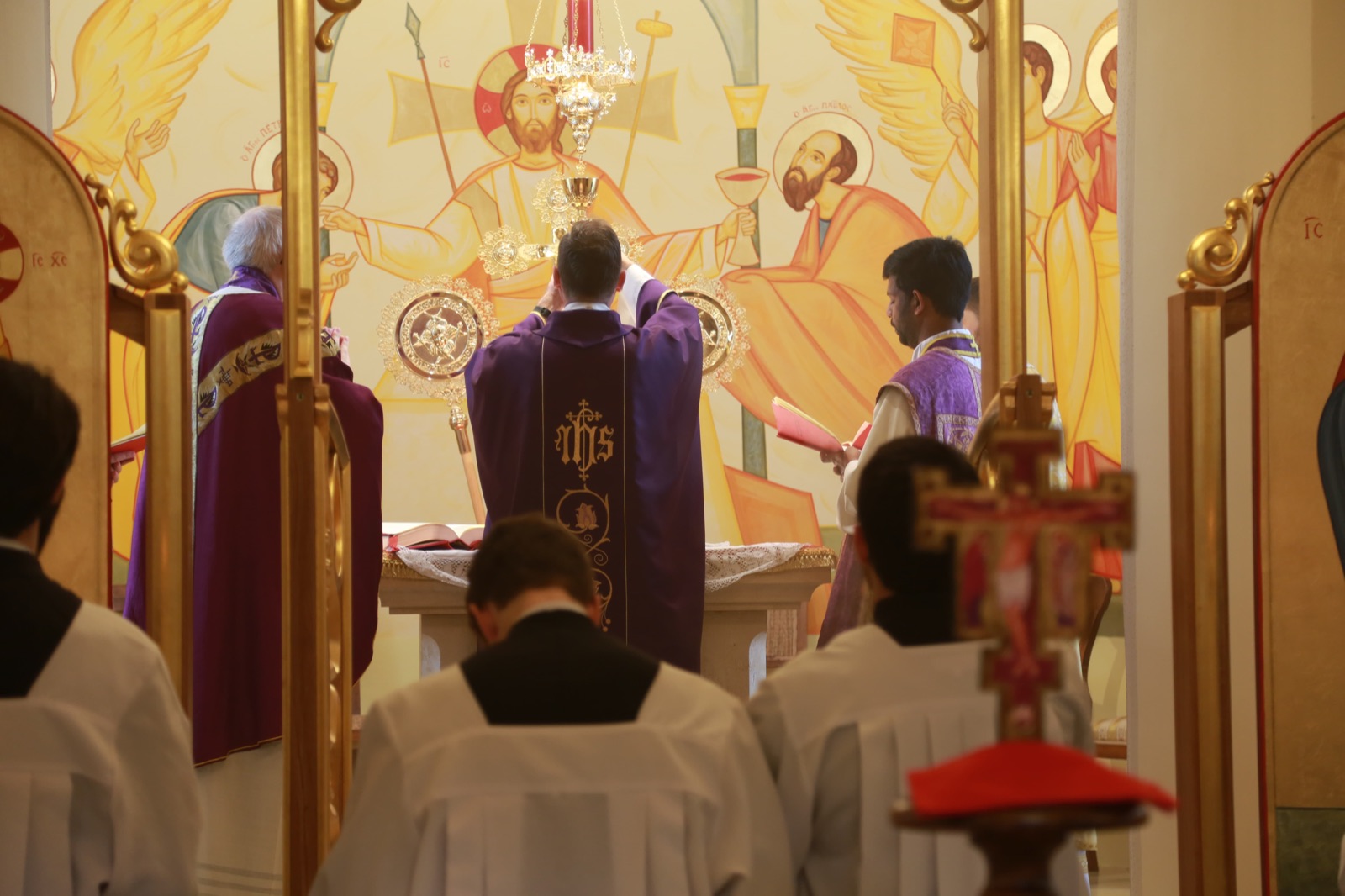
For those discerning priesthood or religious life. Seminarians, religious, and lay men and women preparing for the Church's service will find a full pontifical formation in theology, studied from the sources and lived within a community of prayer.
Baccalaureate in Sacred Theology
A five-year pontifical degree in theology, studied from the sources and recognized in Austria as the Magister theologiae.
Faith seeking understanding.
Theology here is the ordered study of God, received from Scripture, read with the Fathers, and held within the living tradition of the Church. It is not information gathered for its own sake but the formation of the whole person, joining study, prayer, and community into a single search for the truth who is God, and drawing the mind more deeply into the faith it seeks to understand.
What is this, in short?
Quick Facts
STB · Mag. theol.
Degree
5 years
Duration
English
Language
Autumn
Start
Is this for me?
For those called to study theology deeply.
For those who want to teach and hand on the faith. You want more than a general acquaintance with religion. You want to read Scripture, the Fathers, and Aquinas closely enough to teach them, and to give an account of the faith with clarity and care.
For those ready for serious theological work. You are willing to learn the languages, follow the arguments, and let study become prayer. You want a first cycle solid enough to carry you toward the Licentiate and a life of theological service in the Church.
What will I actually study?
From the sources to a whole theology.
Sacred Scripture read directly, the Church Fathers, the great councils and creeds, and St. Thomas Aquinas, together with the philosophical foundations that theology presupposes: these are the disciplines of the five years below. The STB follows the pontifical first-cycle sequence in three phases, and the complete course list is set out in the STB course catalog.
Years 1–2 · Philosophy & Foundations
- Foundations of the liberal arts
- Logic and the art of reasoning
- Ancient and modern philosophy
- Latin
- Introduction to Sacred Scripture
- Catechism of the Catholic Church
Years 3–4 · Sacred Scripture & Systematic Theology
- Old and New Testament
- Fundamental theology
- The triune God and creation
- Christology
- Patrology and St. Augustine
- Church history
Year 5 · Synthesis & Aquinas
- St. Thomas Aquinas
- Sacraments and ecclesiology
- Moral theology
- Canon law and liturgy
- Synthesis thesis toward the STB
Complete course descriptions for the STB program. Program courses are subject to change.
How does a seminar actually work?
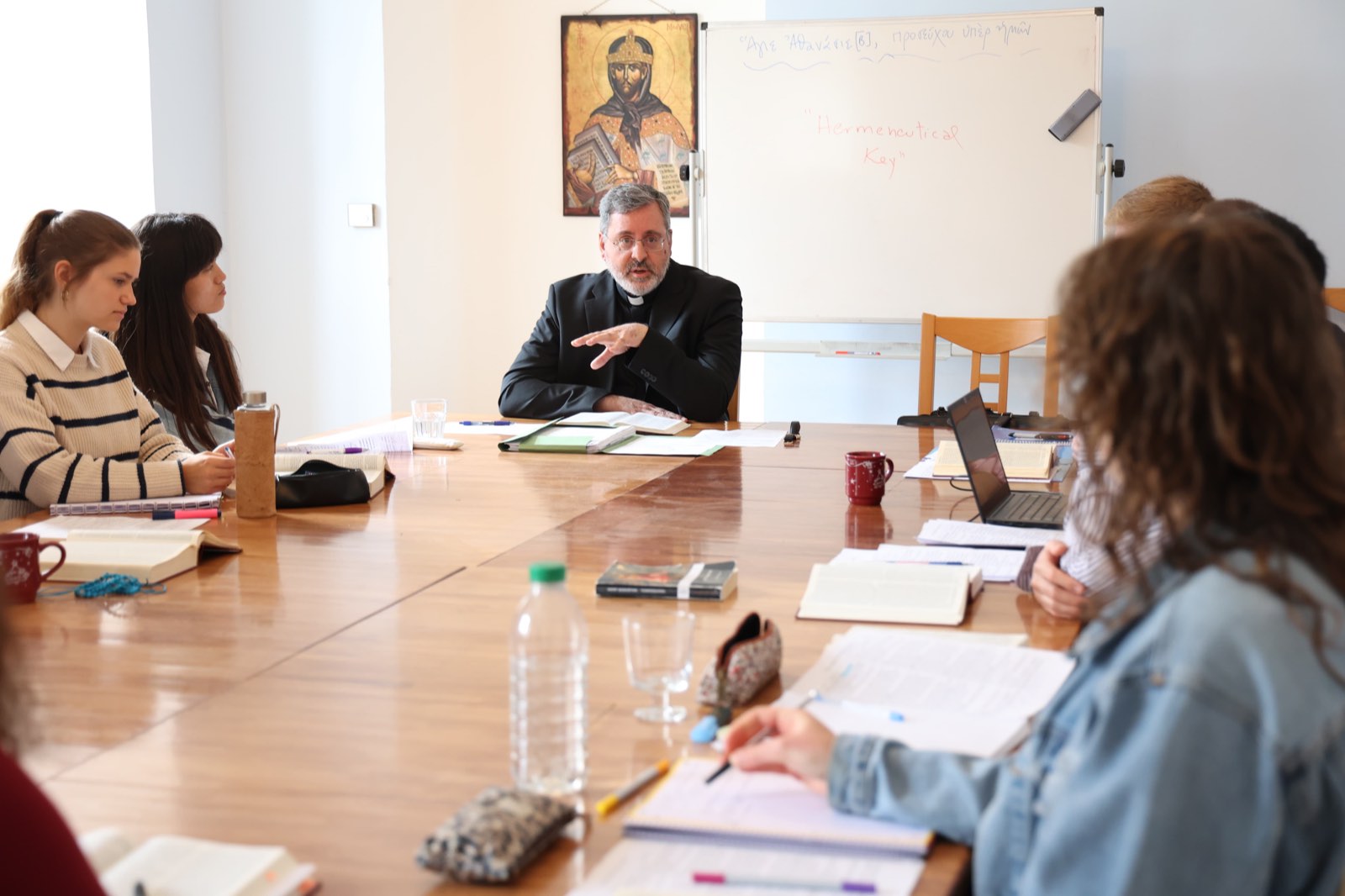
The masters give the lecture. The seminar is the argument.
Every course is a seminar, and no class may exceed fifteen participants; most gather about a dozen students around one table, with a student-faculty ratio of one to four. You prepare by reading and re-reading the assigned pages of Scripture, the Fathers, and Aquinas, because these writings, taken whole, are treated as the lectures of the university. In class the professor opens the text and then asks: you bring your own questions, examine what others have said, and argue from principles to conclusions, addressing one another by last name because the discussion is a public act. Electronic devices stay closed unless a professor allows them. Every class is obligatory, and more than two absences in a course normally means it cannot be completed.
- Written work is of two kinds: a divisio textus, an outline of the author's argument, which many professors expect for every assigned reading, and papers, on average three per term, due one week after the end of exam week.
- Grades follow a ten-point scale, from probatus to summa cum laude. A cumulative average of 8.5 is needed to continue in good standing.
- The course load is capped at 24 ECTS per term, with the classical and biblical languages added on top.
- Applicants with some Latin or Greek take a placement test during Orientation Week, as do those whose classical language studies lie more than four years back.
- The final degree grade is 80 percent course average and 20 percent the STB thesis; within that thesis grade the written text counts 90 percent and its public presentation 10.
What kind of life is this?
Theology is the one discipline whose subject can hear you.
The STB therefore forms its students on their knees as much as at the desk: five years in which the daily liturgy of both lungs of the Church carries the daily reading of Scripture, the Fathers, and St. Thomas.
Seminarians, religious, and lay students study side by side, each with a spiritual director, each preparing for a different way of handing on what they receive here: in parishes, classrooms, families, and missions across the world.
Where does this lead?
Parish, classroom, and the second cycle.
Continue into the Licentiate. The STB is the ordinary path into the second cycle, the Licentiate in Sacred Theology (STL), and from there toward the doctorate for those called to teaching and research.
Teach and hand on the faith. The degree prepares students for catechesis, teaching, publishing, and other work in which Scripture, doctrine, and careful judgment are handed on to others.
Serve in ministry. For seminarians and religious, the STB provides the theological formation that grounds priestly and pastoral service in the Church.
Discern a vocation. Residential Catholic life gives students time and space to discover how study, prayer, friendship, and mission belong together, and to become free for what God asks.
Graduates, and where they went
-
Katherine Gardner
Teaching at Thomas Aquinas College, California, after a PhD at Ave Maria University
-
Kenton Biffert
Dean of Students at Our Lady Seat of Wisdom College, Barry's Bay
-
Jutta Graf
Founder and leader of Privatschule Die Lerche, a Catholic school in Linz
What do graduates say?
What these years become in a life.
“I arrived in Trumau with questions I could barely name. I left with a way of life.”
When I came to ITI, I thought I was choosing a degree. What I actually found was a community that took my questions seriously: professors who read Plato and Aquinas with us line by line, friends who argued about truth over dinner and then knelt beside me at Mass the next morning. Slowly, study and prayer stopped being two separate things in my life. They became one movement toward the same God.
These years gave me more than knowledge. They taught me how to read slowly, how to speak honestly, and how to judge what matters. Today I serve in pastoral ministry and continue my theological studies, and hardly a week passes in which something from those years in Trumau does not resurface: in a conversation, in a decision, in prayer.
I am more grateful for my time at ITI than I can easily say. It gave me my closest friendships, it gave me the intellectual foundation I stand on, and it gave me the certainty that a life ordered to truth is possible. If you are discerning this path: come and see. These years will stay with you for the rest of your life.
Practical Details
What applicants need to know.
Prerequisite
A secondary-school qualification that meets university entrance requirements, such as the Austrian Matura, German Abitur, or British A levels. U.S. applicants should contact Admissions to confirm the requirements for their high school qualifications. Holders of a Bachelor with strength in philosophy and theology may enter directly into the fourth year.
English
English is the principal language of instruction. Applicants who have not completed at least two years in an English-speaking environment or at a school with English as the main language of instruction must submit a standardized test score, such as TOEFL iBT 75 or equivalent.
Languages
Latin is a prerequisite for admission. Students admitted to STB 1 without sufficient Latin complete Latin Grammar I to III and Intermediate Latin I, whose credits do not count toward the degree. Greek is required before the second phase begins in STB 4. Hebrew I to III are mandatory and their credits do count toward the STB.
Degree
On completion, ITI awards the pontifical STB together with the Magister theologiae (Mag. theol.), recognized by the Austrian state under the Concordat.
Thesis
The first cycle concludes with a thesis of at least 60 pages, or 100,000 to 120,000 characters. Title and adviser are chosen by May 31 of the fourth year, the full draft is due March 31 and the final text April 30 of the fifth year. It is graded by the adviser and presented to the adviser and the Dean, with all faculty and students invited. It may be written in English, German, or another modern language by agreement.
Documents
Use these for exact requirements, course descriptions, policies, and current academic regulations.
What does it cost?
Tuition, made possible.
12 000 €
Tuition / year
300 €
Registration / year
from 3 000 €
Housing / year
Regular tuition is 25 000 €. Every accepted student automatically receives the Standard ITI Scholarship.
How do I apply?
Everything you need to apply.
For most applicants, the best order is simple: gather your documents, ask for recommendations early, complete the online application, and then follow through quickly on language or visa requirements if they apply to you.
Applications close on July 1 for the academic year beginning in autumn.
Your application checklist
Use this as a working list while you prepare your application.
01
Prepare your documents
Ask for the recommendation letters first: they are the one part of the application you do not control. The rest is a working list.
02
Complete the online application
The application itself is a single online form. Submitting it opens your file with the admissions office.
03
Prove your English
If your previous schooling was not primarily in English, book a standardized test early enough for the score to reach ITI before the deadline. The threshold is listed under the requirements.
04
Apply for a visa in good time
If you need a visa or residence permit, start early. ITI advises submitting residence permit materials before March 1, since the process can take up to six months.
What else do people ask?
Questions applicants usually ask.
Do I need Latin or Greek beforehand?
Latin and Greek are required for the study of theology from its sources, but you do not need them before you arrive. Students who begin without them can prepare through preparatory courses offered alongside the program.
Is the program residential?
Yes. The STB is a full-time residential program in Trumau, where study, the liturgy, and community life belong together.
What English level do I need?
English is the principal language of instruction. If your previous schooling was not primarily in English, you will need a standardized English test score.
What can I do after the STB?
The STB opens into the second cycle, the Licentiate in Sacred Theology (STL), and prepares students for teaching, ministry, and further theological study.
Take the next step
Apply now
If you are ready for an education where study, prayer, and community belong together, apply now. If you are still discerning, plan a visit and experience ITI in person.