For students who want to read great texts. You want to sit with the sources of the classical, Judeo-Christian, and Catholic traditions and read them directly, slowly, and in company, not to gather information, but to think well.
Studium Generale
A one-year Catholic liberal arts formation in small great-books seminars: a year to read deeply, discern, and, if you wish, continue into the Bachelor.

A year set apart.
The Studium Generale is a single year of Catholic liberal arts formation in the classical, Judeo-Christian, and especially Catholic traditions. In small seminars you read great texts directly and speak with them, joining study to a life of prayer within a living Catholic community. It is a year set apart to read deeply, to deepen your faith, and to discern the vocation God has placed in your heart before committing to a full degree.
What is this, in short?
Quick Facts
1 year
Duration
English
Language
max. 15
Seminar size
July 31
Apply by
Is this for me?
A year to read, deepen your faith, and discern.
For students who want to deepen their faith. You want a year in which study, prayer, liturgy, and friendship belong together, lived within a Catholic community that takes both your questions and your faith seriously.
For students who want to discern a vocation. You are not yet ready to commit to a full degree. You want time and space to discern where God is leading, before choosing whether to continue into the Bachelor in Liberal Arts.
What will I actually read?
One year of the great conversation.
Great texts of the classical, Judeo-Christian, and especially Catholic traditions, read alongside philosophy, theology, literature, and history: these are the disciplines of the single year below. All students follow one core curriculum, so the whole group shares the same texts, the same seminars, and the same pilgrimage through the year.
The Sources
- Great texts of the classical tradition
- Scripture and the Judeo-Christian sources
- The Catholic tradition, read directly
- Close reading in small seminars
Reason & Faith
- Philosophy
- Theology
- The Catechism of the Catholic Church
- Literature and history read alongside
Community & Pilgrimage
- Shared prayer and liturgy
- Cooperation with Heiligenkreuz Abbey
- Retreats and a tour of the Abbey
- The Monastery's Holy Mass
- A pilgrimage to Mariazell
Overview and course descriptions for the Studium Generale year. Program courses are subject to change.
How does a seminar actually work?
Prepared, present, and expected to speak.
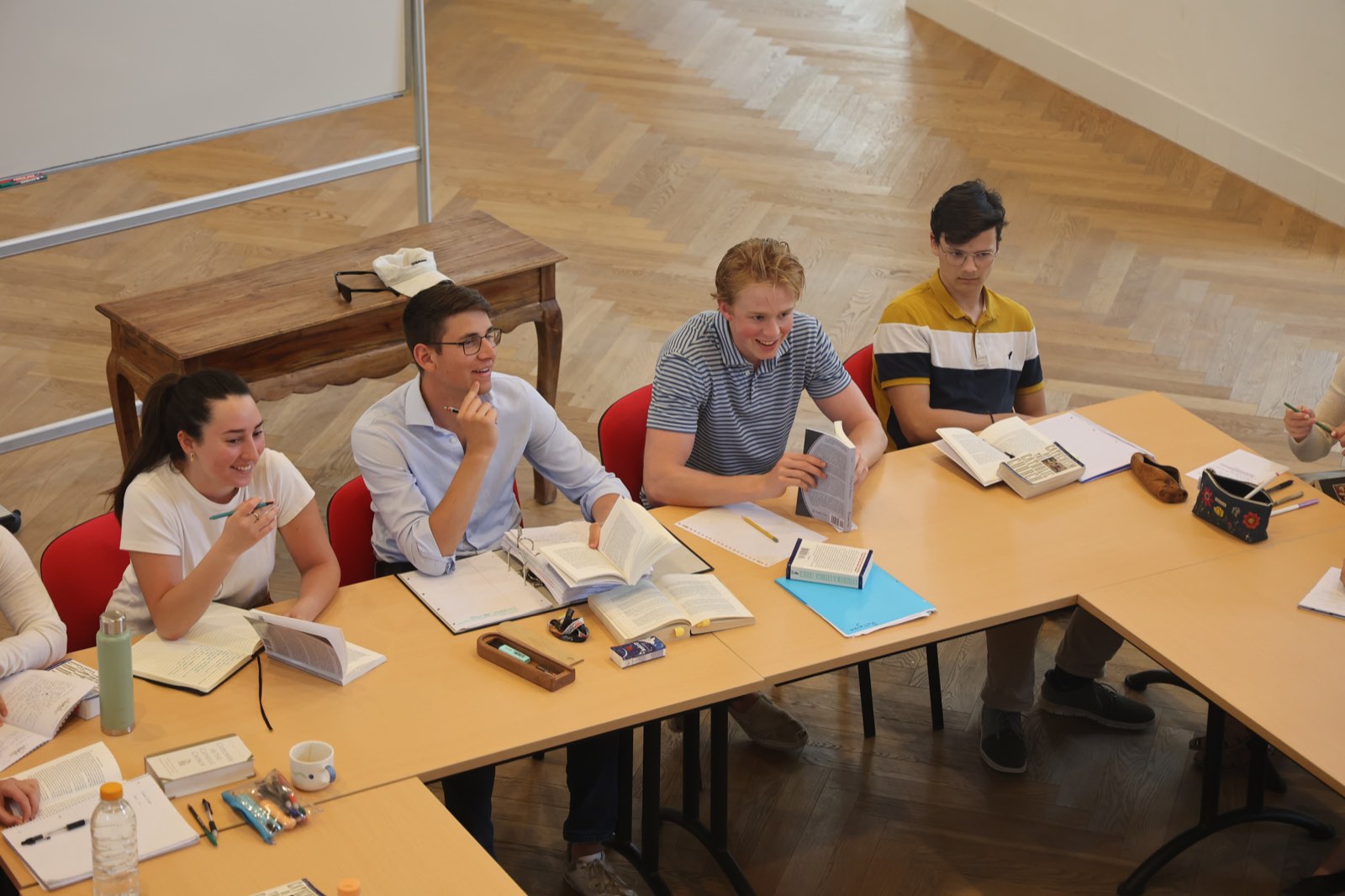
The year is taught entirely in seminar, and no class may exceed fifteen participants; with a student-faculty ratio of one to four there is no back row to sit in. You prepare by reading and re-reading the assigned pages, because the books themselves are treated as the lectures of the university. In class the professor opens the text and then asks: you bring your own questions, examine what others have said, and argue from principles to conclusions, addressing one another by last name because the discussion is a public act. Electronic devices stay closed unless a professor allows them. Every class is obligatory, and more than two absences in a course normally means it cannot be completed.
- Written work is of two kinds: a divisio textus, an outline of the author's argument, which many professors expect for every assigned reading, and papers, on average three per term, due one week after the end of exam week.
- Final examinations are not a test of hasty memorization. They ask you to draw a term of reading together into one whole.
- Grades follow a ten-point scale, from probatus to summa cum laude. A cumulative average of 8.5 is needed to continue in good standing.
- Guest lectures on some Thursday evenings count as part of the instruction, and attendance is required.
- The year is a credit-only program: courses carry ECTS and appear on your transcript, which is what makes the step into the second year of the Bachelor possible.
What kind of life is this?
One year in which studying and believing happen in the same place.
For many students that is new. One year is short, but a year of daily Mass, close reading, and real conversation is long enough to change what you want from the rest of your education, and often from the rest of your life.
The habits formed here are the point of the year: reading slowly, praying regularly, speaking honestly, living with others. Whether students continue into the Bachelor or return home, they leave with a foundation that does not expire.
Where does this lead?
Into the Bachelor, or home with a foundation.
Continue into the Bachelor. Students may apply to the Bachelor in Liberal Arts and, if accepted, enter directly into the second year of the program.
A stronger foundation for further study. The year gives you a coherent grounding in the liberal arts and credit-bearing courses whose ECTS can transfer, strengthening any further study you undertake.
Clarity in discerning a vocation. A year of study, prayer, friendship, and pilgrimage gives you time and space to discern where God is leading, and to become free for what he asks.
A formation that stays with you. Whatever you choose next, the reading, judgment, and life of prayer formed in this year remain a foundation you carry into the Church and the world.
Graduates, and where they went
-
Anne Mette Frey
Associate professor of chemical engineering at Aarhus University; head of the parish council of Denmark's largest Catholic parish
What do graduates say?
What this year becomes in a life.
“I came for one year to read and to discern. I left knowing where I wanted to go.”
When I arrived in Trumau, I only meant to give myself a year: to read great texts, to pray, and to see more clearly before committing to a full degree. What I found was a community that took my questions seriously, small seminars where we read line by line, and friends who argued about truth over dinner and then knelt beside me at Mass the next morning. Slowly, study and prayer stopped being two separate things.
The Studium Generale gave me more than a reading list. It taught me how to read slowly, how to speak honestly, and how to judge what matters. The retreats and the pilgrimage to Mariazell gave the year a rhythm I still carry, and the time it gave me for discernment was the very thing I had come for.
I am more grateful for that year than I can easily say. It gave me some of my closest friendships and a foundation I still stand on. When it ended, I knew I wanted to continue, and I am now in the Bachelor in Liberal Arts. If you are discerning this path: come and see. This year will stay with you.
Practical Details
What applicants need to know.
Prerequisite
A secondary-school qualification that meets university entrance requirements, such as the Austrian Matura, German Abitur, or British A levels. U.S. applicants should contact Admissions to confirm the requirements for their high school qualifications.
English
English is the principal language of instruction. Applicants who have not completed at least two years in an English-speaking environment or at a school with English as the main language of instruction must submit a standardized test score, such as TOEFL iBT 75 or equivalent.
Languages
No ancient languages are required.
Progression
Students may apply to the Bachelor in Liberal Arts and, if accepted, enter directly into the second year of the program.
Documents
Use these for exact requirements, course descriptions, policies, and current academic regulations.
What does it cost?
Tuition, made possible.
12 500 €
Tuition / year
300 €
Registration / year
from 3 000 €
Housing / year
How do I apply?
Everything you need to apply.
For most applicants, the best order is simple: gather your documents, ask for recommendations early, complete the online application, and then follow through quickly on language or visa requirements if they apply to you.
Applications close on July 31 for the academic year beginning in autumn.
Your application checklist
Use this as a working list while you prepare your application.
01
Prepare your documents
Ask for the recommendation letters first: they are the one part of the application you do not control. The rest is a working list.
02
Complete the online application
The application itself is a single online form. Submitting it opens your file with the admissions office.
03
Prove your English
If your previous schooling was not primarily in English, book a standardized test early enough for the score to reach ITI before the deadline. The threshold is listed under the requirements.
04
Apply for a visa in good time
If you need a visa or residence permit, start early. ITI advises submitting residence permit materials before March 1, since the process can take up to six months.
What else do people ask?
Questions applicants usually ask.
What is the Studium Generale?
It is a one-year Catholic liberal arts and discernment program: a year to read great texts in small seminars, deepen your faith, and discern a vocation before committing to a full degree.
Can I continue into a degree?
Yes. Students may apply to the Bachelor in Liberal Arts and, if accepted, enter directly into the second year of the program.
How large are the classes?
Small. Seminars are capped at fifteen students, so preparation, speech, and listening all matter.
When is the deadline?
The application deadline is July 31 for the coming academic year.
Take the next step
Apply now
If you are ready for an education where study, prayer, and community belong together, apply now. If you are still discerning, plan a visit and experience ITI in person.